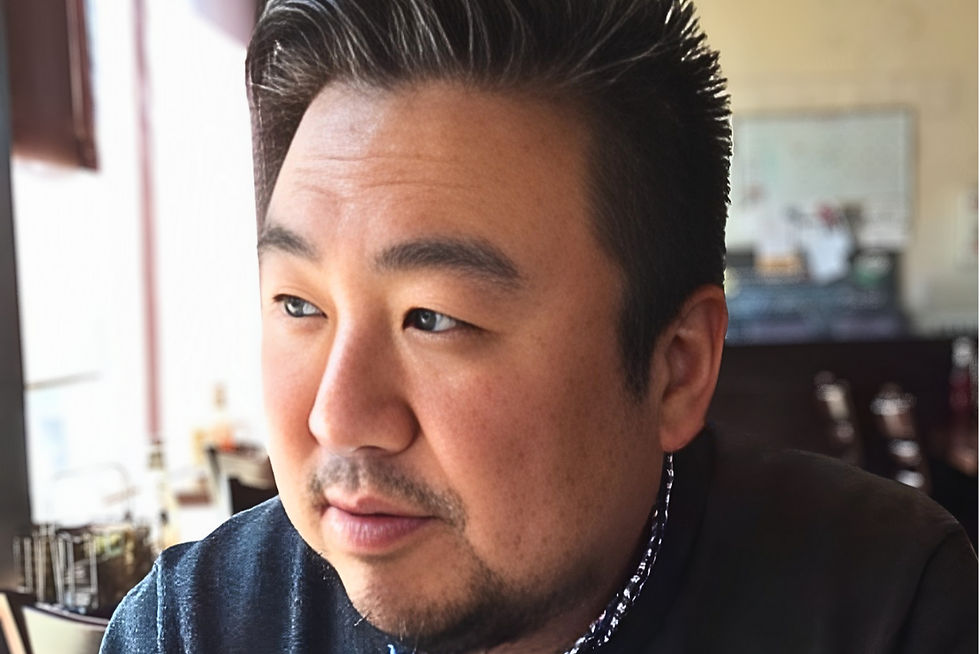
Gideon Evans: Executive Producer & Co-Host, Bad Elizabeth

Gideon Evans spent six years at The Daily Show with Jon Stewart, produced Emmy-winning work with Michael Moore on TV Nation and The Awful Truth, and earned a Daytime Emmy nomination as executive producer of My Grandmother's Ravioli with Mo Rocca, along with a lifetime ban from Walt Disney World for arriving while wearing an eight-foot chicken costume. He is now the co-host and executive producer of the podcast Bad Elizabeth. We talked about what gets cut in the name of comedy, what it means to work without a boss for the first time, and the concepts that haven't found their form yet.
You've produced inside major network structures and now you're creating something of your own with Bad Elizabeth. What did you discover about your own instincts once the institutional structure wasn't there to confirm or deny them?
Honestly, it's a relief to get outside the institutional structure. Within the structure, there's almost always someone who can nix my ideas. It all works well when the boss giving notes truly wants the product to improve, but we all know that is not often the case. The ulterior motives for notes run the gamut — from political reasons, to self-preservation, and pure ignorance or a terrible sensibility. So it has been fun working on this independent project, listening to my gut and not getting into my own head trying to anticipate how my boss would react to every choice. That said, my experience within the institutional structure has taught me valuable lessons, as constraints are very valuable for the creative process.
At The Daily Show, the news was the raw material but the show was the product. What was getting cut that the audience never knew existed, and what did that loss feel like?
The challenge for anyone who has worked for — or is currently working at — The Daily Show is that they must do all the heavy lifting of a legitimate news network. Telling the news stories with a quick turnaround is hard enough; adding a layer of comedy daily is not easy. Obviously comedy works when there's a very simple narrative about the news. Today's hot-button issues are rarely simple; therefore, for jokes to work, the topics must be boiled down to a simple story. When you work on a comedy show, nuance — or shades of gray — must be dispensed with for the material to work. You don't miss the nuance, but in the back of your head you know what you're doing is kind of manipulative.
But then again, actual news is pretty darn manipulative even without the comedy. Look at any show on Fox News or MS NOW — there just isn't enough time to tell the whole story. It's a problem, and with people getting news from apps like TikTok, it's getting worse and worse.
With Bad Elizabeth, you're choosing which Elizabeths make the cut. What's the criteria that you can't put in a pitch document but you know immediately when a subject has it?
In order for an Elizabeth to make the cut, first, they need to be named Elizabeth or a variation of the name. But apart from that, there needs to simply be enough fodder for a good — and hopefully fun — discussion. Some of these historic figures are truly bad and could fit the bill, but the bad acts are essentially the same bad thing over and over. In cases like these, there's a concern the story might get stale and repetitive after fifteen minutes.
We also need to check various sources to make sure the facts are not just rumors. Especially with earlier historic figures — such as the Hungarian "Blood Countess" Erzsebet Bathory — some of those outrageous things about her legend might have been made up or propaganda. We went with Bathory as an episode, but think we should be careful and qualify these things during the episode.
What's the decision that looks small from the outside but that you know changes everything about whether something works?
For my co-host Kathy Egan-Taylor and me, taking that extra step with the research makes a huge difference that the listener wouldn't necessarily recognize immediately. It wouldn't be hard to do an episode by listening to a couple of other podcasts on the same subject before our recordings. But both Kathy and I want to make sure we are really doing our due diligence by uncovering fascinating facts in obscure sources and reading thick books on the subject.
Podcast listeners are generally much smarter than television audiences, and it's not as easy to get away with cutting corners. You either have the goods on a subject or you don't, and it's almost impossible to fake it.
What's the concept you keep returning to that you haven't figured out how to make yet, and what's the one thing still missing that would make it possible?
There are so many concepts I return to over and over regarding the podcast and other projects in my life. With Bad Elizabeth, we have discussed whether the Elizabeths we profile on the podcast have to be real or whether we can think outside the box. Could we choose a literary character? So far, we think they should be real, but we reserve the right to change our minds. For example, Elizabeth Bennet from Pride and Prejudice could be an episode. Also, does the Elizabeth we feature even have to be a person? Could we do an episode about the city Elizabeth, NJ? Or can we do an episode about the Cameron Crowe film Elizabethtown? Stay tuned to find out.
As for concepts I return to outside the podcast, there are too many to name. I have a few film ideas I want to write — one a horror film, one a film about baseball — but I haven't found the time to crack those "nuts" yet. It's all about motivation and finding the time. But I believe there's a lot of potential in these ideas, I just need to get them done.
When Gideon talks about nuance, he's talking about everything that didn't make the cut — the stories that got boiled down for a punchline, the ideas that never found their form, the years spent inside institutions learning what he trusted and what he didn't. Getting out of the structure didn't change what he knows. It just gave him room to use it.
Learn more about Gideon at:
• IMDb